

EL Clinical Study • February 2015
How to combine bone stability and aesthetic benefits through innovative implant design Treatment of a 65-year-old patient
Henriette Lerner HL DENTCLINIC, Dentist, Baden-Baden, Germany
We present a clinical case with extensive aesthetic requirements, illustrating the treatment of a 65-year-old patient with a partial edentular situation with all the teeth having a mobility grade of 2. All the maxillary teeth were extracted and the implants were immediately set.
Introduction
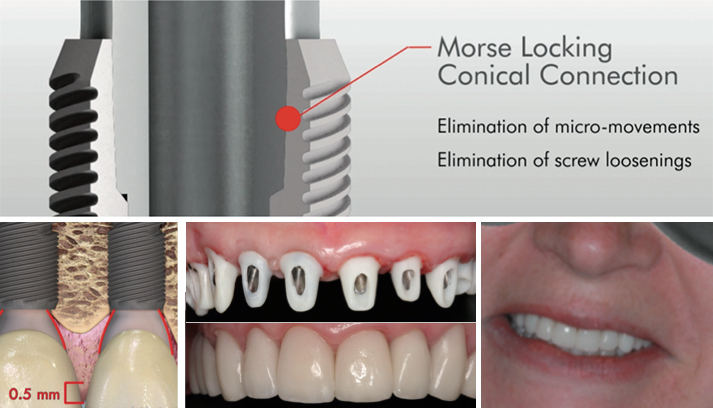
It has been demonstrated that the cone Morse connection is the most stable type of connection. It has been scientifically proven that bone loss is caused by micro-movements and not by the size of micro-gaps (Hermann et al.). It has been reported that normally the micro-gap in implant connections, which allows accumulation of bacteria, measures 21 to 60 μm, facilitating the development of local inflammations and bone loss. The cone Morse connection is distinguished by an inner wall angle of the connection that is less than 25°. Consequently, this is the safest connection against bacterial accumulation since the size of the micro-gap (1.1-1.5 μm) is smaller than that of a bacterium (2-6 μm).
It is also the most stable connection known to date, as well as having the lowest incidence of screw loosening (0.37%). Furthermore, it has shown high resistance to bending during shear tests at 800 N at 30 degrees.
Discussion and conclusion
For this clinical case an innovative implant and prosthetic concept was implemented, allowing the dentist to create and stabilise the peri-implant bone and gingival structure. This implant design and treatment method seems to allow a better aesthetic result in situations where there are adjacent implants.
Click here to download (.pdf format) – EL Clinical Study – February 2015
Трехлетнее ретроспективное исследование, включающее двухлетнее клиническое наблюдение. Henriette Lerner, DMD – Download pdf
C-Tech Dental Implants

Esthetic Line
Implant

Narrow Diameter
Implant

Gingival Level
Implant

Monoblock
Implant

Small Diameter
Implant
Scientific Publications
EL Clinical Study – September 2014 – Innovative dental implant design shows improved success rate, bone stability and esthetic benefits
Innovative dental implant design shows improved success rate, bone stability and esthetic benefits […]
(BDIZ EDI) Implant-Study 2014/2015 – March 2015 – Quantitative and qualitative element-analysis of implant-surface by SEM and EDX
Quantitative and qualitative element-analysis of implant-surface by SEM and EDX (BDIZ EDI) Implant- […]
EL Clinical Study – April 2015 – Bone stability and aesthetics using an innovative implant design
Bone stability and aesthetics using an innovative implant design EL Clinical Study • April 2015 Im […]
Innovatives Dental-Implantat-Design – May 2015 – Improved Success Rate, Bone Stability, Esthetic Advantages
Improved Success Rate, Bone Stability, Esthetic Advantages Magazine PIP – Issue:2/2015 • May 2015 […]
Serbian Dental Journal – October 2015 – IMMEDIATE LOADING OF DENTAL IMPLANTS USING INTRAORAL WELDING TECHNIQUE – CASE REPORT
Immediate loading of dental implants using intraoral welding technique – case report Serbian Dental […]
Erste Daten eines neuartigen Implantatsystems – November 2015 – Frankfurt University FORM EL Study Presentation
Frankfurt University FORM – EL Study Presentation Erste Daten eines neuartigen Implantatsystems • N […]
School of Dental Medicine University of Belgrade, Serbia – November 2015 – Clinical outcomes following horizontal ridge augmentation with bone block grafts
Clinical outcomes following horizontal ridge augmentation with bone block grafts School of Dental M […]
BİZE ULAŞIN